 Cape Dreams News from in and around the Cape
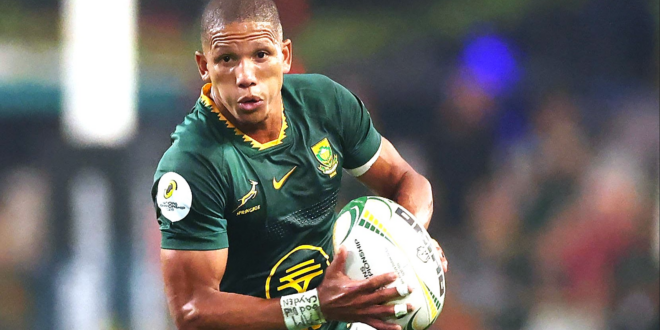
After coming on as a substitute last week, he showcased his flair and tactical awareness.
HERMAN GIBBS
11 September 2026 – Manie Libbok produced an exceptional performance last week as the Springboks secured a hard-fought 29-24 victory over their traditional rivals, the All Blacks.
His dynamic contribution was pivotal as the Boks clinched a 2-1 lead in what has truly become Rugby’s Greatest Rivalry series.
Libbok, who stepped in as an early first-half substitute for fullback Cheslin Kolbe, made his presence felt immediately upon entering the fray, showcasing his flair and tactical awareness.
After the match, the quest for answers surrounding the absence of Libbok in the ‘starting lineup has once again come to the forefront. Despite his undeniable talent and potential, the player has found himself primarily on the substitutes’ bench, much to the confusion and frustration of fans and analysts alike.
After countless explanations from Bok coach Rassie Erasmus about why he opted to deploy Libbok off the bench, the debate has resurfaced repeatedly, lingering like a shadow over the Springbok camp.
One pundit was moved to remark: “Manie Libbok gets the Boks humming when he’s on the field. When he came on, he created, kept the defence guessing,
“But he doesn’t get the same love that Sasha (Feinberg-Mngomezulu) does, by any means, or Handrè (Pollard), to be fair. He gets some love for sure, but not the same level.”
Erasmus has carved a reputation as a strategist who prioritises teamwork over individualism. His appointment in March 2018 heralded a new era for South African rugby, one characterised by meticulous preparation and a cohesive unit that responds to challenges as one.
During a memorable encounter at a Newlands brewery shortly after his appointment, I had the opportunity to engage in an impromptu discussion with Erasmus. As someone keen on the game’s ever-evolving dynamics, I posed a challenging question about his insistence on thorough preparation: could his approach stifle the creativity of talented players?
Erasmus’s response was insightful and reflective of his coaching philosophy. He explained that fostering instinctual play among his athletes could lead to confusion. “When a player plays on instinct,” he stated, “his teammates won’t know his next move, and if it goes wrong, the necessary support may not be in place.”
At the time, I thought that was fair enough, but in the rigid world of rugby coaching, the voice of one of the game’s great thinkers, Danie Craven, echoes as a reminder of instinct and creativity on the field. Known for his astute understanding of the game, Craven once implied that the role of a flyhalf could be better served by trust rather than direction.
Craven’s philosophy also brings to mind the remarkable talent of players such as the mercurial Michael du Plessis and Dawie Snyman. The latter made history as a Springbok before ever donning the Western Province (WP) jersey, showcasing how remarkable instincts often transcend traditional paths.
Craven’s faith in players who could dictate the game, rather than be told how to do so, may have paved the way for these exceptional athletes, whose capabilities were nurtured by the freedom to express themselves on the pitch.
One memorable moment that encapsulates Craven’s ideology occurred in the early 1990s during a schools’ rugby match between Paul Roos Gym and Bishops. Intrigued by the unfolding dynamics, Craven joined the Bishops’ halftime team talk led by coach Basil Bey. He interjected with a powerful directive: ‘Don’t tell your flyhalf what to do. Let him run your game.’
Coach Bey, struck by Craven’s insight, turned to his No 10 and said, ‘You heard what Doc said. You make the calls.’ This advice proved invaluable; Bishops overcame a halftime deficit to snatch victory, showing the power of trusting players’ judgment.
By this time, Erasmus, with two World Cups under his belt (2019 and 2023), is rightfully regarded as one of the greatest tactical minds of his generation. His expertise and coaching acumen have guided the Springboks to unprecedented heights.
Under his mentorship, players like Cheslin Kolbe and Damian Willemse have transformed from promising talents into mainstays of a world-class team, contributing significantly to South Africa’s current ranking as the world’s No. 1 rugby union team.
Erasmus’s coaching approach centres on letting players play to their strengths and encouraging a style of rugby that celebrates individualism. This philosophy has redefined the Springboks’ landscape, paving the way for players to express themselves on the field in ways that enhance team performance. Kolbe’s dazzling footwork and Willemse’s agility are a testament to Erasmus’s belief that a player’s autonomy can drive collective success.
However, the narrative takes an interesting turn when we consider Manie Libbok. Despite being an exceptionally talented player with the potential to shine in this structured yet free-flowing setup, Libbok appears to be grappling with the intricacies of having the same latitude Kolbe and Willemse enjoy.
Critics argue that giving Libbok room to showcase his talents could further elevate the team’s performance, allowing more creativity and innovative playmaking in crucial moments.
As rugby fans worldwide continue to dissect Erasmus’s strategies and the team’s dynamics, the question remains: why not extend this privilege to all players, including Libbok?
If the Springboks are to maintain their superiority on the global stage, it may depend on fully embracing each player’s personality, including Libbok, nurturing their innate talents, and trusting them to flourish on the field.
